
Most people use ChatGPT or Copilot like a search engine: a few words, press enter and hope. What comes back reads smoothly, but it is generic. The conclusion is quickly drawn: “AI isn’t that smart yet.”
Usually the problem is not the model, but the question.
The new colleague test
Imagine a smart new colleague starts tomorrow. You would never say: “Write an email about the project.” You would tell them who the email is for, what you want to achieve with it, what has already happened and what it should look like.
A language model needs exactly the same. It even misses what that colleague still has: the coffee break where they pick up the rest of the context. A language model always predicts the most likely next word. Give it a vague question, and you get the most likely answer: the average one.
The difference in one example
Vague:
Write an email about the new planning tool.
Briefed:
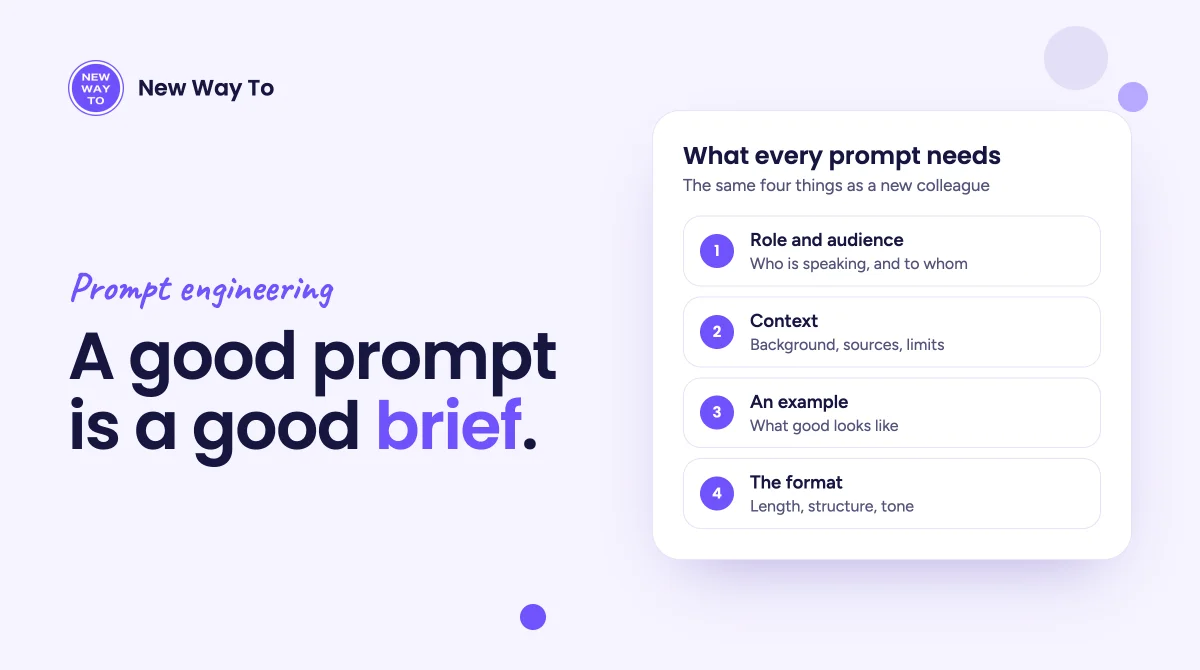
You are our HR manager. Write a short email to all team leads, who are not technical, about the new planning tool that launches on 1 March. Goal: get them to sign up for a 30-minute demo. Use the tone of this previous announcement: […]. No more than 120 words, with one clear action at the end.
The second prompt contains a role, an audience, context, an example and a format. That is four extra sentences, and you do not have to rewrite the result three times.
Three habits that make the biggest difference
- Give an example. One good example says more than a paragraph explaining tone and structure. It is the biggest win for the least effort.
- Say what you do want. “Write in short sentences for managers without a technical background” works better than “not too technical”. A model follows instructions better than prohibitions.
- Keep what works. A prompt that gives good results is really a work instruction. Save it, share it with your team and test it again when the model changes. That is how a personal trick becomes a shared standard. Why that rarely happens by itself, you can read in Why Good Practices Do Not Spread by Themselves.
And once the basics are in place?
That is when it really starts. You can have a model think before it answers, ask you questions before it begins, or check its own answer before you use it. And with settings such as temperature, you decide whether you want a creative or a predictable answer. For a brainstorm you want the first, for reading invoices the second.
Download the Prompt Engineering Toolkit
We bundled it all into a free toolkit (9 pages):
- 29 prompting techniques, each with when to use it and concrete examples
- recommended settings for factual, balanced and creative tasks
- 15 best practices and the pitfalls to avoid
- a step-by-step plan to bring it all together in your own work