1) A real-world scenario
You look at two teams doing similar work.
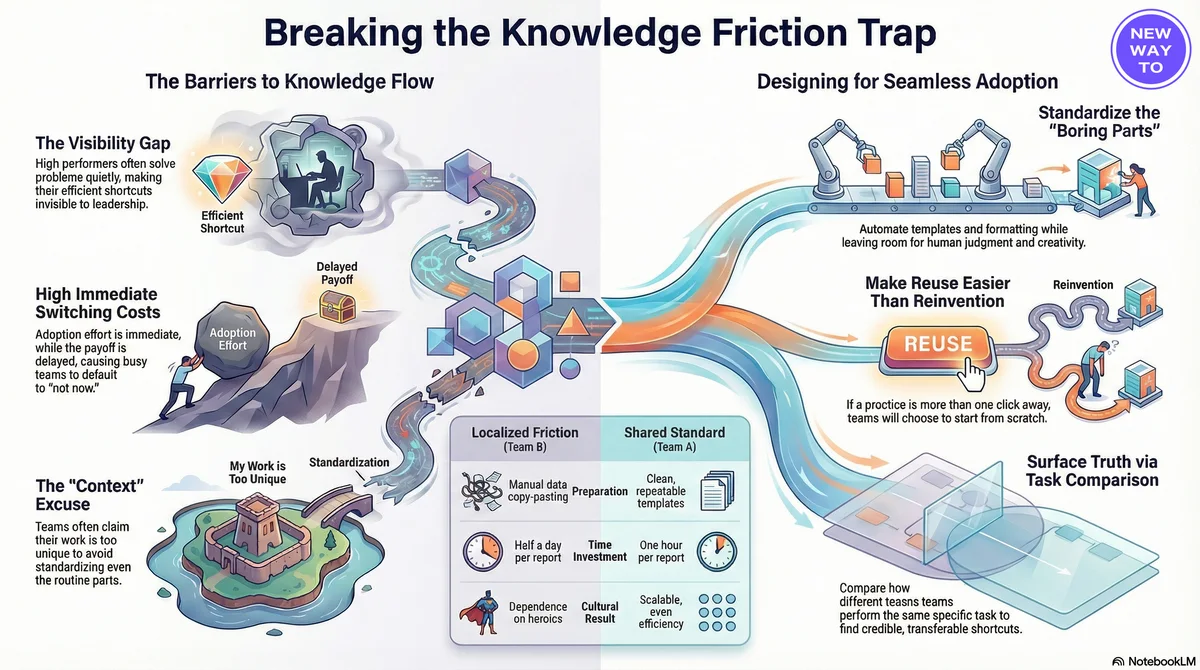
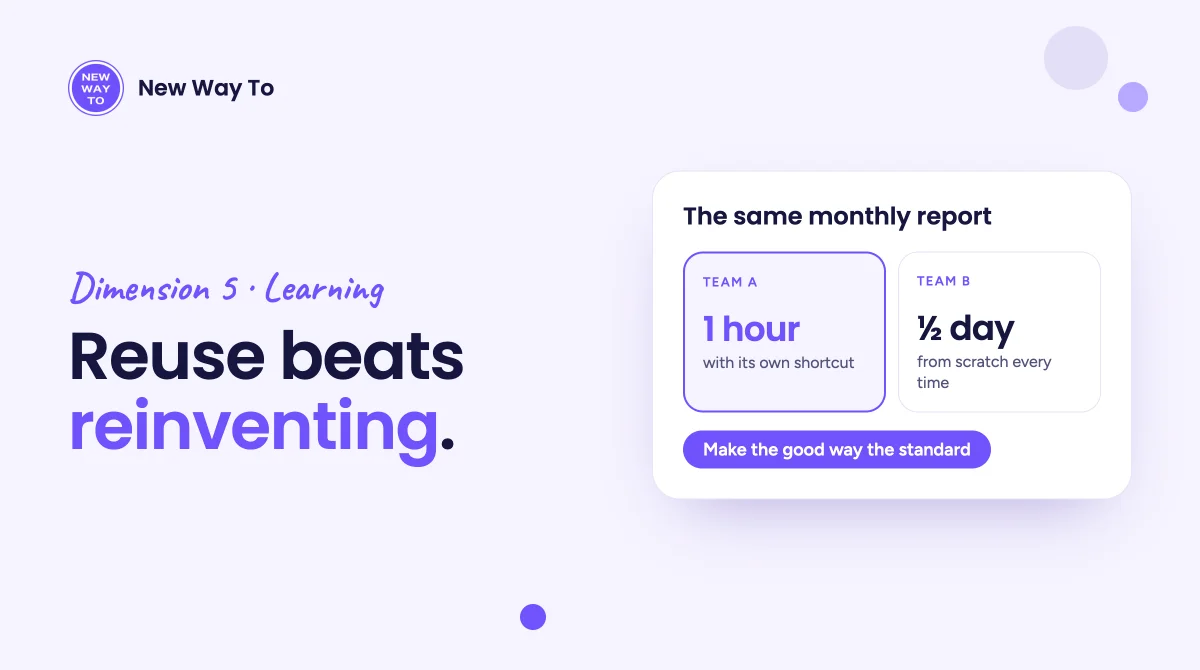
In team A, a monthly report takes one hour. They have a clear template, a repeatable workflow and a few smart shortcuts. In team B, the same report takes half a day. They copy and paste data by hand, chase inputs and fix the formatting of the final version.
Both teams are capable. Both teams care about quality. Yet the better way of working stays locked inside one team.
When you ask why it does not spread, you hear phrases like:
“We didn’t know they did it that way.”
“We’re too busy to change.”
“It’s different for us.”
“We tried that once before.”
The uncomfortable truth is that organisations often have plenty of good practices. They just do not travel.
2) The underlying pattern
Many organisations assume that improvement spreads by itself. Someone finds a better way, other teams copy it, and efficiency rises.
In reality, learning usually stays local. It gets stuck in pockets because of three barriers:
Visibility. Good practices are often invisible. People do not announce their shortcuts. They solve problems quietly. Leadership sees outputs, not how the work was done.
Transfer cost. Adopting a better way of working takes effort: adjusting templates, learning a tool, changing habits, aligning with colleagues. Even when it is better, the switching cost is now and the payoff is later. So busy teams choose “not now”.
Context excuses. Teams often believe their work is unique. Sometimes that is true. Often it is not. “It’s different for us” becomes a convenient reason not to standardise the boring part.
This creates a predictable dynamic:
- High performers keep optimising locally
- Others keep reinventing
- The organisation becomes dependent on personal workarounds
- Efficiency stays unevenly spread
The uncomfortable truth is that many organisations reward individual heroics more than shared standards. People get recognition for solving problems, not for making problems less likely.
3) Why common fixes fail
When leaders see inconsistency, they often try to fix it with broad initiatives.
Fix 1: Provide more training. Training raises awareness, but rarely changes daily workflows. People leave inspired and come back to the same friction. Without integration into real tasks, training becomes a memory, not a habit.
Fix 2: Publish a best-practice library. Libraries are useful, but often turn into graveyards. If finding and applying something takes effort, busy teams will not do it. The best content is content that shows up at the moment the work happens.
Fix 3: Standardise everything. Over-standardisation creates resistance. It can also destroy legitimate flexibility. Teams then see standards as bureaucracy and build shadow processes.
Fix 4: Ask people to share more. Knowledge-sharing sessions help, but they are not enough. Sharing is not the same as adoption. Adoption needs ownership, incentives and a mechanism to turn a good idea into a shared way of working.
The uncomfortable pattern is that learning does not spread because the system does not make spreading easy.
4) What actually helps
If you want better ways of working to spread, treat it as a design problem: lower the friction, lower the risk and make adoption the default.
Make good practices visible by comparing tasks. The fastest way to find transferable practices is to compare how different people do the same task. Not abstract conversations. Real tasks. Once you see the differences, the better approach becomes visible and credible.
Standardise the boring part, not the expertise. Most tasks have a stable core: inputs, templates, data extraction, formatting, approval steps. Standardise that. Leave room for judgement and creativity where it matters.
Create lightweight default workflows. Teams resist heavy processes. They accept defaults. A default workflow is a recommended path that is easy to adopt and easy to improve. It is a direction, not a rigid rule.
Build internal champions with a clear job. Champions should not be cheerleaders. They should be practical translators: taking a good practice, adapting it to another team and supporting adoption in the first weeks. You measure success in adoption, not in enthusiasm.
Make reuse easier than reinventing. If the template is one click away and the steps are clear, people reuse. If they have to search, ask around and request access, they reinvent. Many learning problems are really access and friction problems.
Set up a feedback loop that updates the standard. A shared way of working should not freeze. The standard has to evolve based on real use. Otherwise teams drop out and build their own.
Use AI to lower the switching cost. AI can help draft templates, summarise workflows and create step-by-step guides. Its best role is making adoption easier, not replacing clarity.
5) A reflective question
Where in your organisation do you rely on personal workarounds today instead of a shared way of working?