1) A real-world scenario
You lead an improvement initiative that should be straightforward. The team has done the analysis, the proposal is clear, and the next step is a simple decision.
Then the familiar chain reaction starts.
Someone asks: “Does Finance need to approve this?” Someone else says: “Legal may want to review this.” A manager forwards the question to a steering group. Two weeks later the decision comes back, but with new conditions, so the team has to adjust and resubmit.
Nobody is incompetent. Nobody is blocking on purpose. Yet everything slows down, because decisions are not a clean step in the flow. They are a foggy zone that work has to pass through.
For innovation and improvement managers, this is one of the most frustrating forms of waste, because it is hard to name precisely. It hides behind caution, governance and “alignment”.
2) The underlying pattern
Decision friction is not just slow approvals. It is a combination of three elements:
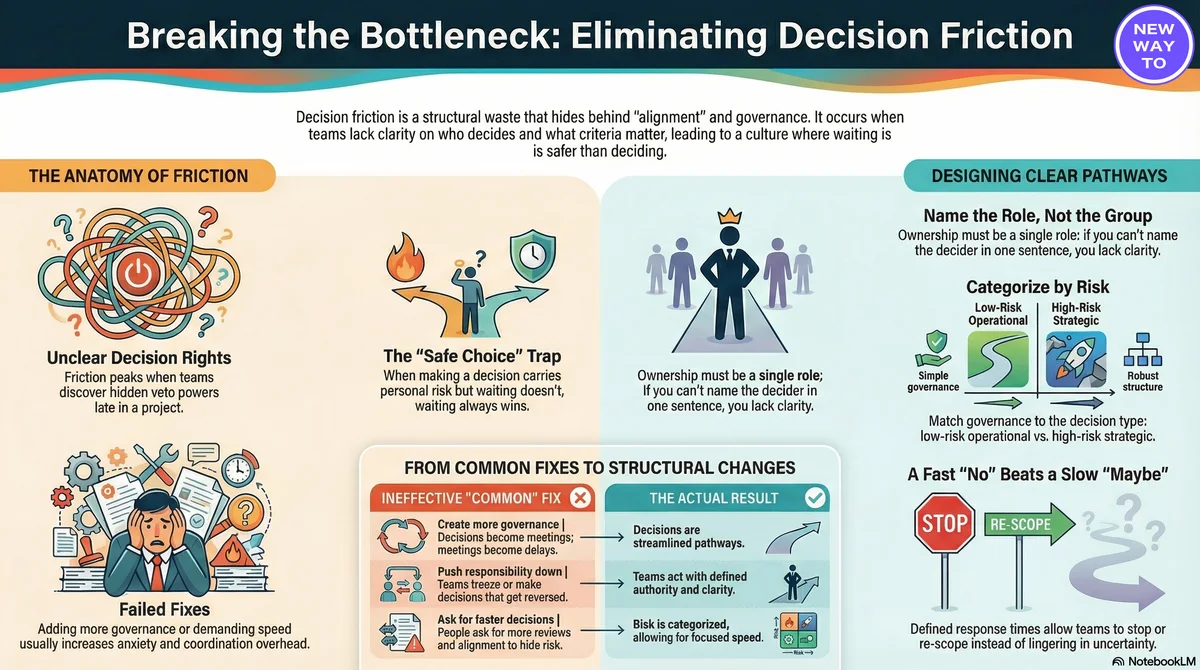
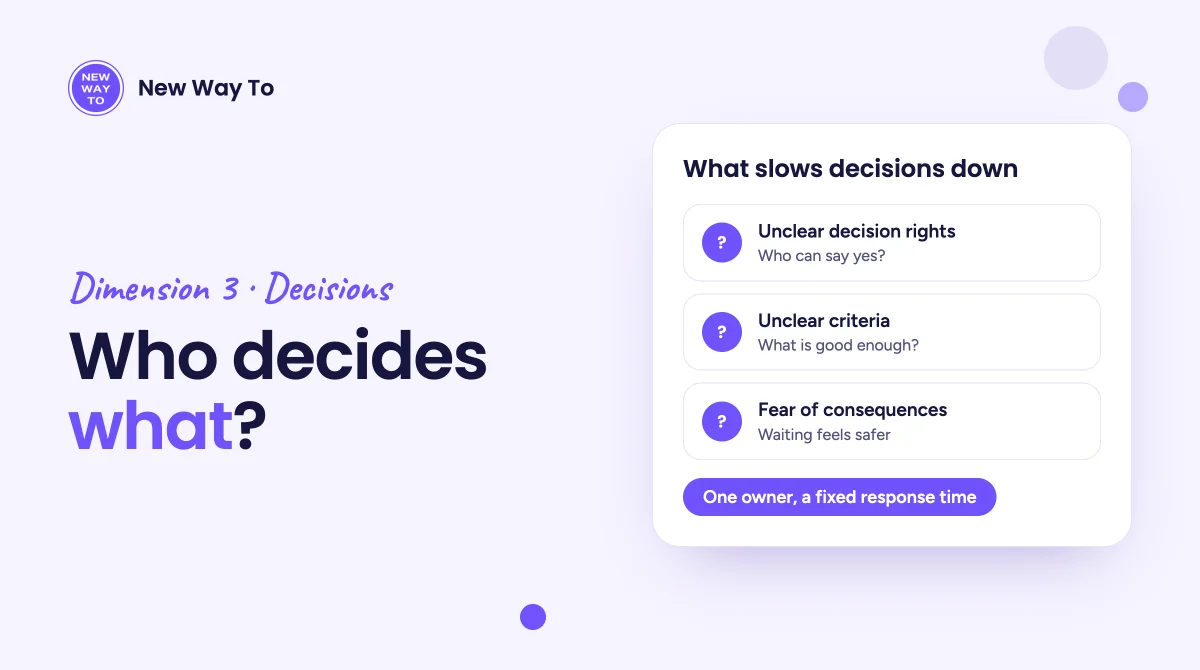
Unclear decision rights. People do not know who can decide. Or worse: they think they know, but later find out that someone else has a veto.
Unclear decision criteria. Even when the decision-maker is known, the team does not know what “good enough” looks like. That causes iterations. Each iteration feels like diligence, but it is rework.
Fear of consequences. In many organisations, escalating or postponing is the safest choice. If deciding carries personal risk and waiting carries none, waiting wins.
The uncomfortable truth is that decision systems often reward caution over progress. That is not a cultural defect. It is a structural incentive problem.
That is why decision friction often grows over time:
- More stakeholders are added
- More approvals are layered on
- More exceptions appear
- More people protect themselves by escalating
The result is predictable: teams do not stop working. They start work around the decision, which creates hidden delays, parallel work and extra follow-up meetings.
3) Why common fixes fail
When decision friction hurts, organisations often reach for solutions that sound logical but do not address the pattern.
Fix 1: Create more governance. Extra committees and steering groups sometimes help with large investments. But applied broadly, they raise the cost of alignment. Decisions become meetings. Meetings become delay.
Fix 2: Ask for faster decisions. This puts pressure on individuals without changing the system that makes deciding risky. People respond by asking for more information, organising more reviews or seeking more alignment, and everything slows down again.
Fix 3: Document everything. Documentation is useful, but it does not resolve unclear decision rights. You can have perfect documents and still not know who owns the call.
Fix 4: Push responsibility down without clarity. Some leaders try to empower teams with “you decide”. When criteria and risk limits are not clear, this creates anxiety and inconsistency. Teams freeze, or make decisions that are later reversed.
The uncomfortable pattern: clarity does not come from asking people to communicate better. Clarity comes from designing decision paths that are explicit and safe.
4) What actually helps
Decision speed improves when you make three things visible: who decides, what they need, and how quickly they respond.
Define types of decisions. Not every decision deserves the same process. Create simple categories, such as:
- low-risk operational decisions
- medium decisions that affect several teams
- high-risk strategic decisions
Match the governance to the category.
Assign clear decision owners. For recurring decisions, name a role that makes the call. Not a committee. A role. Committees can advise, but ownership must be clear.
A practical rule: if you cannot say in one sentence who decides, you do not have decision clarity.
Make decision criteria clear up front. Teams lose time when they have to guess what leadership wants. Make criteria visible. For example:
- cost threshold
- risk threshold
- compliance checks
- impact measures
This reduces rework because teams build the right first version straight away.
Set decision response times. Flow breaks when decisions get stuck. Define expectations. Even if the answer is “not now”, a fast no is better than a slow maybe. It lets teams stop, adjust or rescope.
Replace approval loops with “one accountable, many consulted”. A lot of delay comes from trying to make everyone comfortable. Replace that with a clear consultation model: input is gathered, but one role decides.
Track where decisions get stuck. This is somewhat uncomfortable, but very powerful. If you track decision cycle time across a few initiatives, patterns appear quickly. You see which approvals are redundant, which criteria are unclear, and where fear drives escalation.
Use tools and AI as support, not as a replacement. AI can summarise options, risks and context. But the bottleneck is rarely information. It is ownership and trust. Fix that first.
5) A reflective question
Where in your organisation are people waiting, not because they lack information, but because they are not sure who can say yes?