1) A real-world scenario
A customer request comes in. Sales notes it down and passes it to operations. Operations asks for missing details. Sales goes back to the customer. Meanwhile, someone in planning has already started work based on assumptions. Two days later the request changes because the original input was incomplete.
Nothing dramatic happened. Nobody made a big mistake. Yet the task now carries extra emails, extra meetings, rework and frustration. People start using phrases like:
“Let’s align first.”
“Can you send this again, but with the right information?”
“We already discussed this.”
Handovers like these are so normal that organisations no longer really see them. The work is still moving, so it looks like execution. But under the surface, the system is quietly burning time.
2) The underlying pattern
Most teams try to improve within their own boundary: better templates, better tools, more discipline. That helps, but it misses a core reality:
The biggest efficiency losses often sit on the boundary between teams.
Handovers break for predictable reasons:
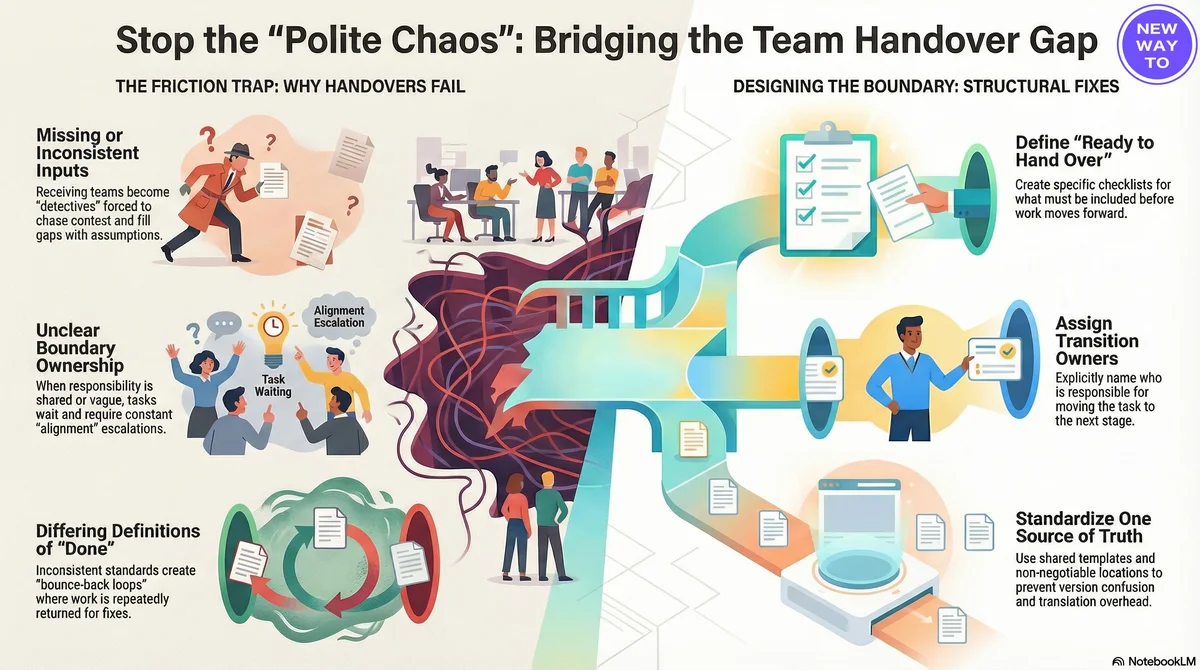
Missing or inconsistent input. Work is passed on without the information needed to continue. The receiving team then turns into a detective. They interrupt others, chase context and fill gaps with assumptions.
Unclear ownership. When responsibility is shared, work belongs to everyone and to no one. People hesitate. They ask for alignment. They escalate. The task waits.
Different definitions of “done”. What “complete” means in one team is “still incomplete” in another. That creates bounce-back loops: work comes back for fixes, and then again.
Tool fragmentation. When teams work in different tools and naming conventions, every handover requires translation. That is pure overhead and causes version conflicts.
The uncomfortable truth is that many handovers are designed as polite chaos. Everyone wants to help, but the system does not make the next step obvious.
3) Why common fixes fail
When handovers hurt, organisations often reach for solutions that feel logical but fail in practice.
Fix 1: Add more meetings. Regular alignment meetings become the default solution. They give a sense of coordination, but they are a tax on flow. They also normalise the idea that work cannot move without synchronisation.
Fix 2: Ask teams to communicate better. This is vague. People already communicate a lot. The problem is not volume. The problem is a lack of structure: which information is required, which is optional, and what happens when it is missing?
Fix 3: Write more documentation. Documentation helps, but it often becomes one more artefact nobody fully trusts. People keep asking in chat. They keep forwarding emails. They keep recreating context.
Fix 4: Appoint a central coordinator. A coordinator can reduce friction in the short term, but quickly becomes a bottleneck too. The organisation becomes dependent on one person to “keep everything moving”.
The uncomfortable pattern: handover problems persist because the system relies on people acting carefully and heroically. That does not scale.
4) What actually helps
Better handovers come from designing the boundary, not from making people try harder.
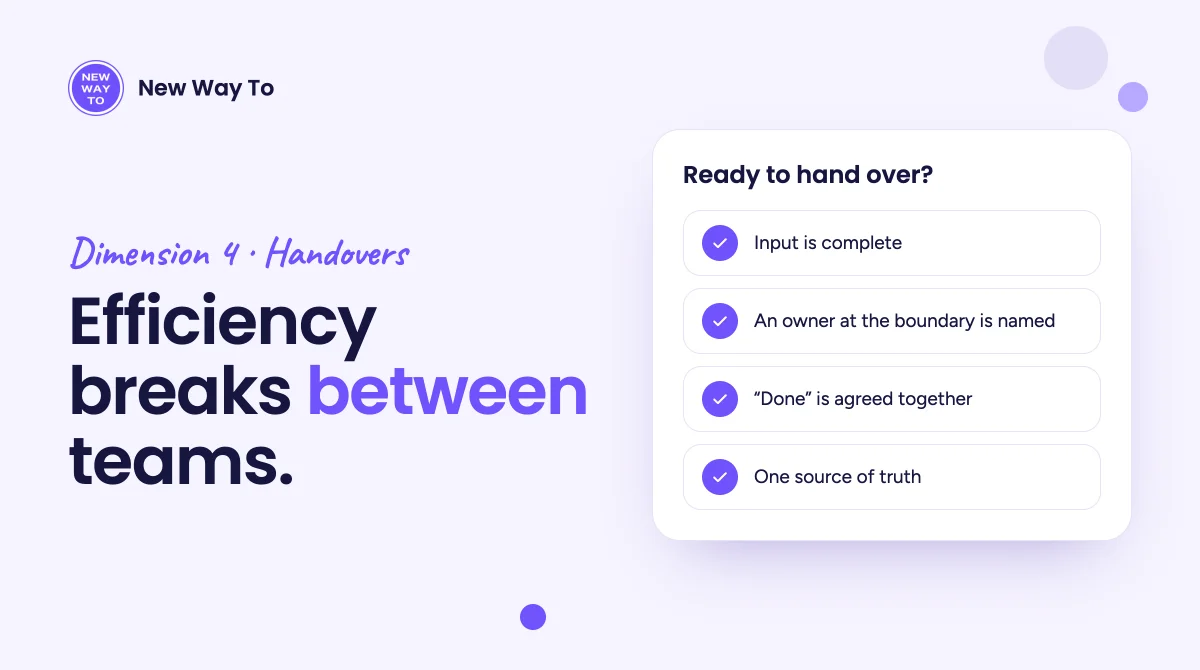
Define “ready to hand over”. For common handovers, define a short checklist: what must be in place before work is passed on. This is not bureaucracy. It is a form of respect for the next team.
Use templates that travel with the work. If a task always needs the same core information, put it in a shared template. The goal: the right input should be the easiest input.
Make ownership at the boundary explicit. Decide who is responsible for moving the task to the next stage. Not who owns everything, but who owns the transition. Many handovers fail because the owner of the transition is unclear.
Reduce bounce-back loops with clear acceptance criteria. Define what “done” means at each step. If the receiving team rejects a handover, there should be a clear reason linked to the checklist or criteria, not a vague feeling.
Make one source of truth non-negotiable. Version conflicts destroy handovers. Agree where final information lives and how it is named. The goal is not perfection, but consistency.
Audit one handover chain, not the whole organisation. Pick a frequent flow that crosses teams, such as customer requests, approvals, onboarding or reporting. Map the handover steps and look for hidden rework loops. Improving one chain often gives you a blueprint for others.
Use automation and AI where they remove translation work. AI can summarise handover context, pull required fields from emails and draft structured requests. But it only works well once the checklist and acceptance criteria are clear.
5) A reflective question
Which flow in your organisation creates the most “bounce-back”, where work comes back because something was missing or unclear?