1) A real-world scenario
You look at your team’s plan and it seems achievable. The backlog is clear. Priorities are aligned. And then it is Tuesday.
A senior manager urgently needs a slide deck. A customer escalation comes in. A dependency on another department is late, so your team cannot move forward. A decision slips to “later this week”. By Friday, people have worked hard, but real progress feels thin.
When you ask what went wrong, nobody says “We were slow.” They say:
“We had to switch constantly.”
“We kept having to restart work.”
“We were waiting on others.”
“Everything became urgent.”
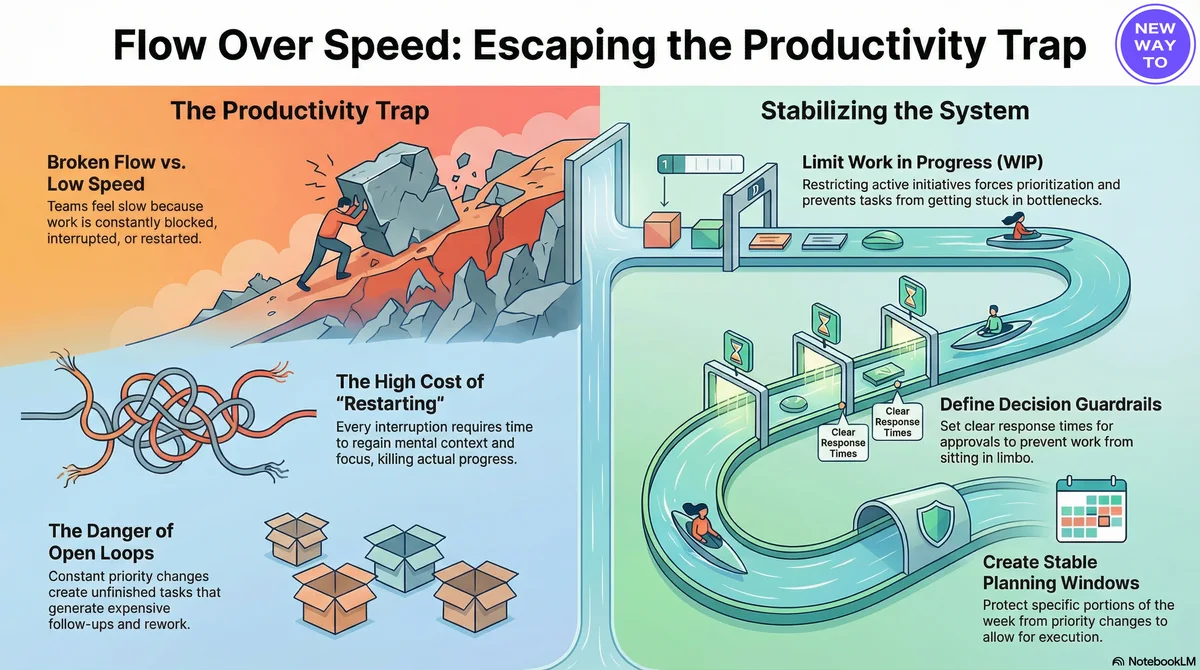
This is the productivity trap. Many teams do not have a speed problem. They have a flow problem.
2) The underlying pattern
In knowledge work, output does not only depend on how fast people type or how many hours they work. It depends on whether work moves through a system without constant restarts.
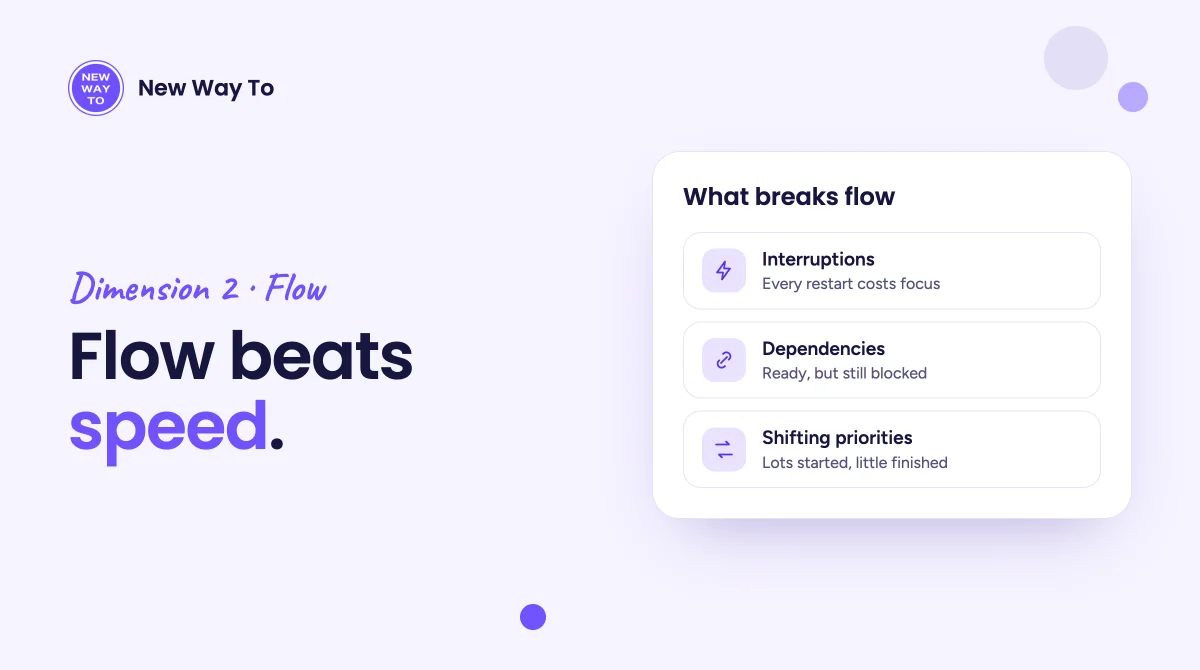
Flow usually breaks for three predictable reasons:
Interruptions. Every interruption has a restart cost. It is not only the minutes spent on the urgent request. It is the lost context, the mental switch and the time it takes to find focus again.
Dependencies. When work depends on others, your team can be ready and still be blocked. Blocked work creates hidden queues: tasks half started, documents waiting for input, decisions in limbo. This raises cognitive load and frustration.
Priority churn. When priorities change often, teams do not finish. They start. Work becomes a collection of open loops. Open loops are expensive. They cause follow-ups, reminders, rework and extra status meetings.
The uncomfortable truth is that a team can look busy and still lose productivity because the system of work is unstable.
Flow is not a vague concept. It is a measurable working condition: how often tasks are interrupted, restarted or blocked.
3) Why common fixes fail
When teams feel chaos, leaders often respond with measures that seem logical but break flow even further.
Fix 1: Add more alignment. Extra check-ins, more stand-ups, more status tracking. This gives a sense of control, but often increases interruptions and context switching. The work gets explained more often than it gets done.
Fix 2: Push for speed. “Go faster.” “We need more urgency.” This increases multitasking. Multitasking feels like progress but creates more restart costs. The result is often slower delivery and lower quality.
Fix 3: Build buffers everywhere. People build slack into every estimate. That protects the individual but hides the system problem. Work still gets blocked, only later, and the organisation loses transparency.
Fix 4: Train individuals in time management. Personal productivity training helps, but it cannot compensate for dependency chains and priority churn. You can have disciplined people in a broken system.
The uncomfortable pattern: you rarely solve flow problems at the individual level. You solve them by stabilising the system.
4) What actually helps
Improving flow is not about perfection. It is about fewer unnecessary restarts.
Make unplanned work visible. Many teams underestimate how much of their week is driven by ad hoc requests. Track unplanned work for two weeks. You do not need a perfect system. A simple categorisation is enough: urgent requests, escalations, missing inputs, rework.
Limit work in progress. When everything is started, nothing is finished. Agree on a maximum number of active initiatives per team. This forces prioritisation and makes dependency bottlenecks visible sooner.
Define decision response times. Flow often breaks because decisions get stuck. Define what “fast enough” means per type of decision. Even a simple rule helps, for example: small approvals within 48 hours, larger decisions within one week.
Reduce dependency friction. Dependencies are not bad, they are normal. The question is whether they are managed. Improve handovers by defining what “ready” means before you pass work on. Use checklists, templates and clear owners.
Create stable planning windows. Many teams plan weekly but let priorities shift daily. A simple guardrail is to protect part of the week as stable execution time and to limit changes to fixed moments.
Use automation and AI where they reduce restarts. AI is most valuable when it removes the busywork that blocks flow: summarising inputs, drafting first versions, extracting data, creating templates. But only after priorities and ownership are clear.
5) A reflective question
Where does your team lose more time: on the work itself, or on restarting the work over and over?